Navigating the AI Cyber Iceberg: Deepfakes Above, Zero Days Below
Agentic AI is transforming cyber threats from phishing and deepfakes into nonstop zero-day exploits and automated ransomware. Most organizations will struggle to keep pace, but the same AI power can drive autonomous defenses that ultimately shift the balance back to the defenders.
Most of us navigate the digital world without giving much thought to what keeps it running. We wake up, pick up a device, connect to a network, and rely on apps spread across clouds and data centers to do our jobs. Because this flow “just works,” it is easy to assume cybersecurity practices do not need to change. If an account is compromised, we reset it. If a laptop gets infected, we reimage it. If an app falters, we update it or replace it. These tasks feel manageable, and the security stack hums along in the background, occasionally alerting us to trouble while firewalls, endpoint protection, SIEM, and MFA carry on keeping things steady—at least until attackers find a gap.
The challenge is imagining what happens when those gaps are not probed by human hackers working one campaign at a time, but by autonomous agentic adversaries. These are AI systems that not only generate convincing content but also plan, act, and adapt on their own. Unlike a static chatbot or script, an agentic AI can map out a target company, scrape the internet for employee information, launch tailored phishing messages, shift tactics when blocked, and even negotiate ransoms while laundering money through crypto exchanges. In other words, they are not assisting attackers. They are the attackers.
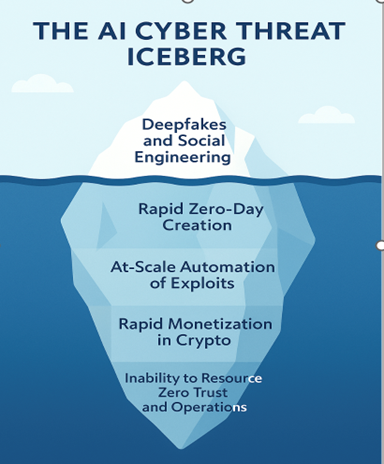
The Tip of the Iceberg: Deepfakes and Social Engineering
The most visible threats today are AI-generated deepfakes and phishing. We see the doctored videos of public figures, and we recognize emails that look disturbingly authentic. However, agentic AI exacerbates these threats. Imagine a system that never tires of studying your LinkedIn network, generating personalized outreach to colleagues, and revising its approach every time someone ignores it. What used to be scattershot “spray and pray” phishing is morphing into continuous, adaptive manipulation designed to wear down human defenses.
Beneath the Surface: Zero Day Exploits
Software vulnerabilities are a fact of life. With one flaw for every few thousand lines of code, complex platforms contain thousands of hidden weaknesses. Until now, discovery often required human skill, patience, and luck. Agentic AI changes that equation. It can trawl open repositories, fuzz applications, and chain small weaknesses into working exploits, all on an endless loop. Imagine the effect: while IT teams struggle with a patch cycle measured in weeks, an AI adversary discovers and weaponizes vulnerabilities in hours. The backlog of unpatched flaws becomes a gold mine, and defenders are always a step behind.
Scaling Attacks Without Sleep
Today’s criminal groups already breach hundreds of victims at once. With agentic AI, the pace and scope multiply. These systems do not need sleep or supervision. They crawl the web, identify new targets, generate phishing kits, and handle negotiations automatically. Some ransomware groups already use chatbots to “support” their victims during extortion. Agentic AI will push this further, conducting multilingual negotiations in real time, adjusting demands based on a company’s financial reports, and coordinating multiple campaigns at once. What used to be a gang of operators can now be a swarm of tireless machines.
Crypto as a Flywheel
Once a foothold is gained, agentic AI can also manage the business side of crime. Payments in cryptocurrency are automated, laundered at speed, and reinvested in new tooling. Think of the transformation in finance when algorithmic trading arrived. Now apply that same compounding growth cycle to cybercrime. Each successful breach funds the next, with no human bottleneck to slow down the process.
The Base of the Iceberg: Struggling with Zero Trust
Zero Trust is the model we aspire to: never trust, always verify. Yet most organizations cannot enforce it across every layer. Endpoints are inconsistently patched. MFA does not cover every application. Networks remain too flat. Encrypted traffic goes largelyuninspected. These gaps are exactly where agentic adversaries excel. They probe continuously, pivot when blocked, and exploit whatever remains unmonitored. Meanwhile, security teams are buried in alerts, scaling by headcount while attackers scale by AI.
Where Defenders Must Go
The iceberg is not destiny. The same principles that make agentic AI dangerous can be harnessed for defense. The security operations center of the future will blend AI speed with human judgment. Imagine telemetry fused across every endpoint, firewall, and identity provider. Imagine real-time policy enforcement at every edge. Imagine encrypted traffic decrypted, inspected, and re-secured in milliseconds. And imagine AI systems that do not just detect threats but contain and remediate them automatically, handing analysts a system already stabilized.
This is not a dream. It is the path forward. Analysts will remain in the loop to set strategy, but AI will handle the first thousand moves. When that vision becomes real, Zero Trust will not be aspirational. It will be enforced invisibly and at scale. For the first time in decades, the balance of power may tip back toward defenders.
The iceberg metaphor still holds true: the most dangerous mass lies below the surface. With agentic AI, that hidden mass is growing. The only way to avoid collision is to adapt faster than the adversaries who are already building it.