Beyond the Operating System: Ransomware in the CPU
Being alert to ransomware is nothing new. Ransomware can wreak havoc and often cause permanent damage to endpoints, unless effective recovery processes are in place. Many ransomware operators attempt to delete shadow copies and other recovery methods, which makes redundancy in recovery essential. However, the situation becomes even more serious with the emergence of microcode ransomware. If the microcode running in the tiny memory of your CPU is infected, recovery becomes far more difficult due to its persistence even after rebooting, a threat that previously seemed unlikely.
A security researcher has recently demonstrated that it is possible to modify UEFI firmware by installing an unsigned patch directly into the processor. This technique bypasses traditional antivirus solutions and operating system countermeasures. While analysts have yet to observe ransomware that operates at the CPU level in the wild, it's important to understand how this potential threat works and to consider which defense mechanisms could be effective against it.
How a ransomware attack works in the microcode
In a proof-of-concept published a few weeks ago, a security researcher managed to carry out a ransomware attack directly in the processor’s microcode. This revealed a little-explored vector that could represent a significant shift in malware evolution. The attack exploits a vulnerability in AMD Zen processors (first to fifth generation), which allows unauthorized microcode to be loaded without proper signature verification. Signature verification is one of the key countermeasures used by operating systems to detect unauthorized changes to critical components like bootloaders. Since microcode governs the CPU’s fundamental behavior, altering it could have a serious impact on system operation.
This vulnerability was flagged by Google when it identified a flaw in AMD's signature validation algorithm and demonstrated its scope through a practical test. In this test, researchers altered the microcode to manipulate the processor's random number generation function. As a result, the CPU always delivered the number 4, regardless of the context of the request. While this example may seem trivial, it demonstrates that it is possible to manipulate fundamental internal processes on the chip. In a real-world scenario, this could be used to compromise sensitive computations, such as cryptographic key generation, interfere with digital signature verification, or manipulate system integrity algorithms.
Yet, the technique of manipulating microcode for malicious purposes is being explored within research environments. Still, the findings bring to the table a vector that deserves to be considered in future defense strategies. So, we wanted to reflect on how we could detect this type of ransomware if it were to materialize in a real attack.
Analysis of anomalous behavior and correlating events across the entire infrastructure are key elements in this context. Deploying tools capable of integrating information from different levels of the system, such as endpoints, networks, servers, or cloud environments, builds a fuller picture and allows us to detect patterns of activity that traditional mechanisms could fail to flag up.
Extended detection and response (XDR) approaches provide valuable capabilities in this respect. Combining advanced behavioral analysis, network lateral movement monitoring, and automated response to suspicious activity helps organizations identify signals that may be related to a ransomware attack. In turn, this strengthens a multi-layered strategy, which is crucial to addressing threats that impact at the hardware level.
The potential development of CPU-level malware adds a new component to ransomware attacks. As the cybersecurity landscape continues to evolve while continuing to bolster detection, prevention and response capabilities will prove critical in mitigating evolving threats.
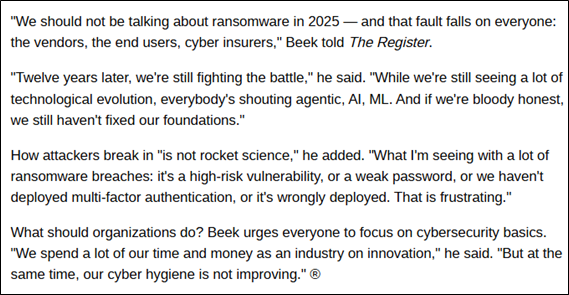
To provide additional context on potential countermeasures, I’m including an excerpt from the researcher on whom this post is based. His analysis is particularly on point, as reflected in the following graphic.