Deployment Overview
This document describes how to set up multi-factor authentication (MFA) for TOPdesk with AuthPoint as an identity provider. TOPdesk must already be configured and deployed before you set up MFA with AuthPoint.
Contents
TOPdesk Authentication Data Flow with AuthPoint
AuthPoint communicates with various cloud-based services and Service Providers with the SAML protocol. This diagram shows the data flow of an MFA transaction for TOPdesk.

Before You Begin
Before you begin these procedures, make sure that:
- An admin (operator) can log in to the TOPdesk Essential environment
- A token is assigned to a user in AuthPoint
- You have an AuthPoint identity provider (IdP) certificate (go to Certificate Management)
Configure TOPdesk
The steps in this section describe how to configure TOPdesk for MFA.
Enable Public SSO or Secure SSO
TOPdesk supports both public SSO and secure SSO. Public SSO is used for a person to log in to the Self-Service Portal, while secure SSO is used for the operator to log in to the Operator Section. You can submit calls and requests in the Self-Service Portal, but you cannot access the Operator Section where these calls are processed.
To start, you must download the metadata file from the Certificate Management page in the AuthPoint management UI. After you have that, you can configure TOPdesk.
- Log in to WatchGuard Cloud.
- From the navigation menu, select Configure > AuthPoint. If you have a Service Provider account, you must select an account from Account Manager.
- Select Resources.
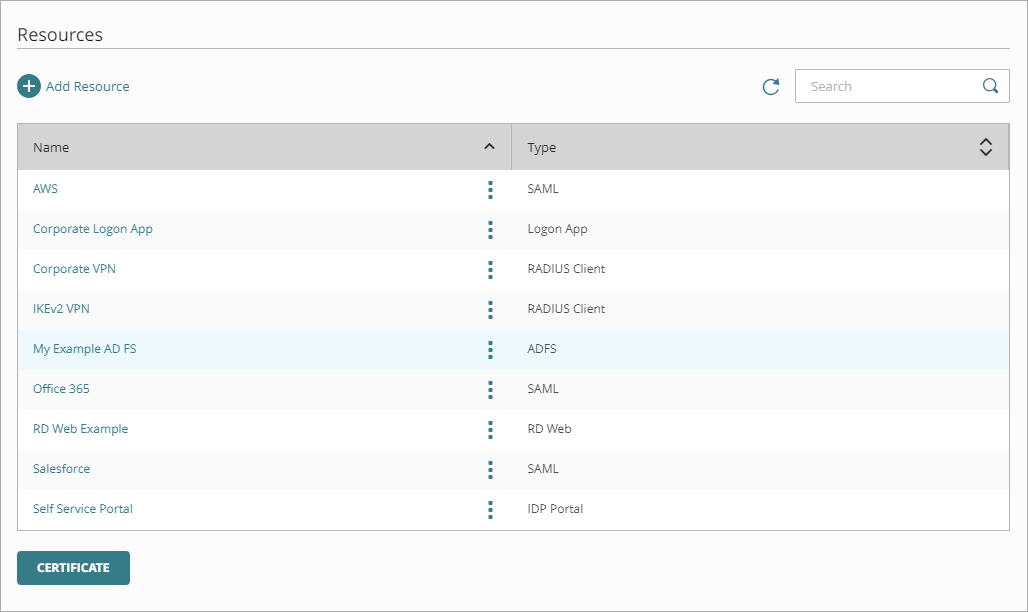
- Click Certificate.
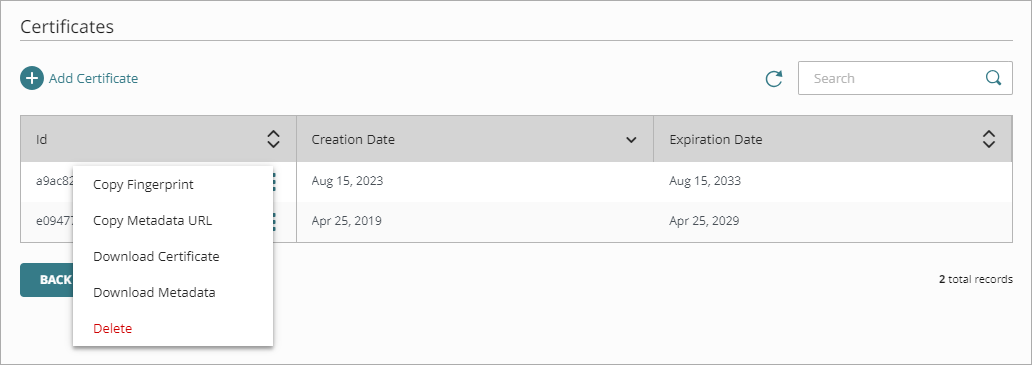
- Next to the AuthPoint certificate that you want to associate with your resource, click
 and select Download Metadata. We recommend that you choose the certificate with the latest expiration date. If you do not have a certificate, or if all of your certificates have expired, click Add Certificate and use the newly created certificate.
The AuthPoint metadata file provides your resource, in this case TOPdesk, with the information necessary to identify AuthPoint as a trusted identity provider.
- Log in to TOPdesk as an administrator.
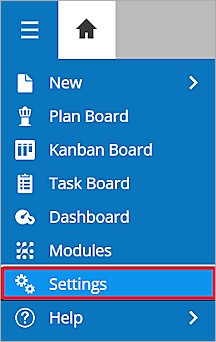
- Select
 > Settings.
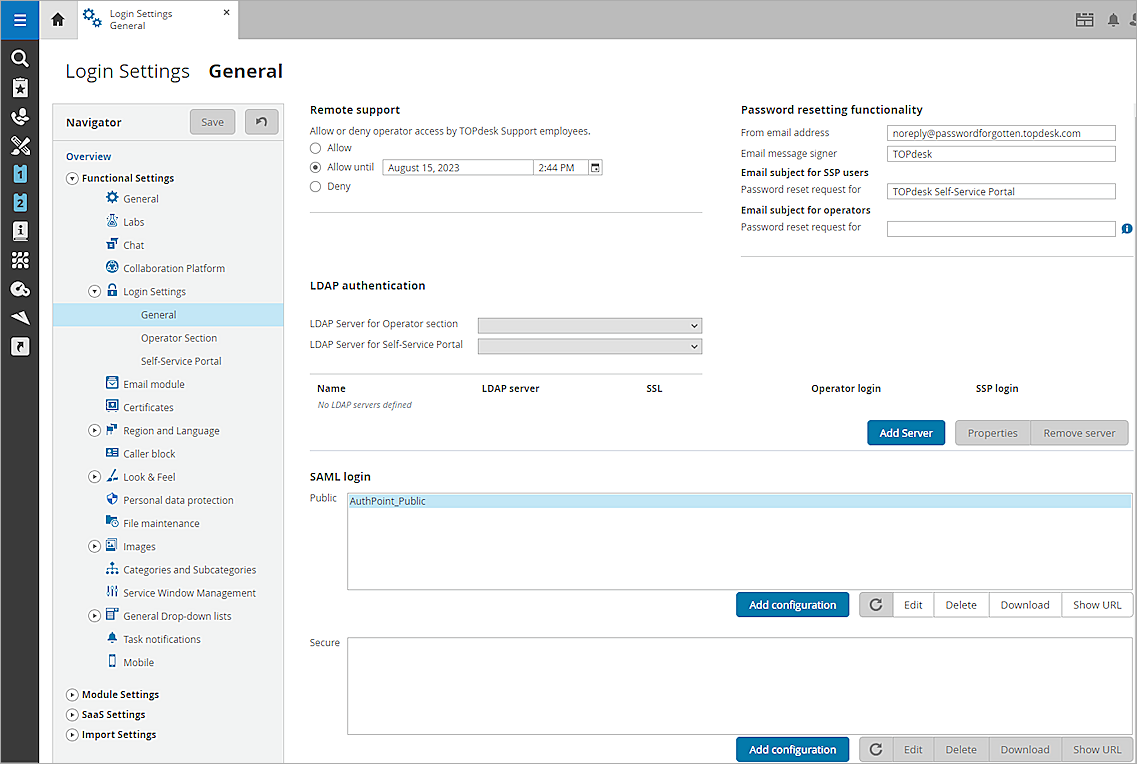
- Select Overview > Functional Settings > Login Settings > General.

- To create a public(Self Service Portal) or secure (Operator's section) SAML 2.0 setup, in the SAML login section, click Add configuration. In this example, we add public SSO in TOPdesk.
- Select Upload as file.
- Click Browse, and then upload the AuthPoint metadata that you downloaded in step 5.
- From the Entity ID drop-down list, select the URL. If the Entity ID is selected, the Logout URL and Logout response URL values are automatically populated.
- In the User name attribute text box, type username.
- Clear the Use signed metadata check box.
- Select Host TOPdesk metadata.
- Clear the Assertions will be encrypted check box.
- Click Generate key pair.
- In the Display name text box, type a display name. In this example, type AuthPoint_Public.
- Leave the default value for other settings.
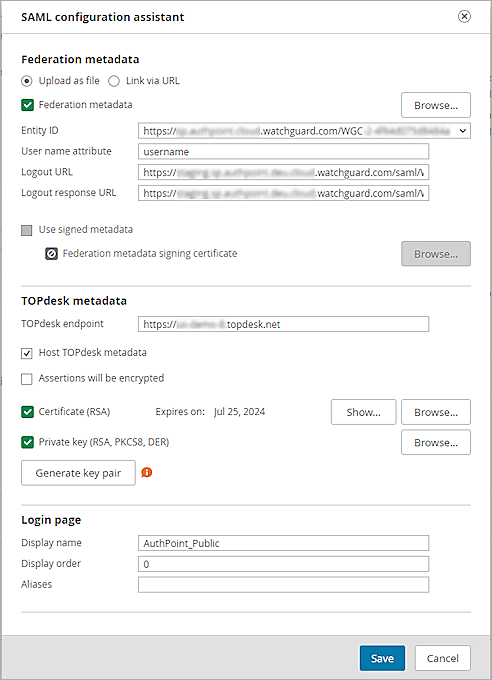
- Click Save. You can also repeat Steps 9–19 to add secure SSO in the Secure section for an operator to log in to Operator Section.
- In the Public section, select the display name you entered in Step 18 (in our example, this is AuthPoint_Public), and then click Download to download the public metadata file and save it on your computer. If you added secure SSO in Step 20, you can also download the secure metadata file in the Secure section. Both the public and secure metadata files can be used in AuthPoint.
- In the left navigation bar, select Functional Settings > Login Settings > Self-Service Portal. If you want to enable secure SSO, select Functional Settings > Login Settings > Operator Section.
- Select the SAML Single Sign On check box.
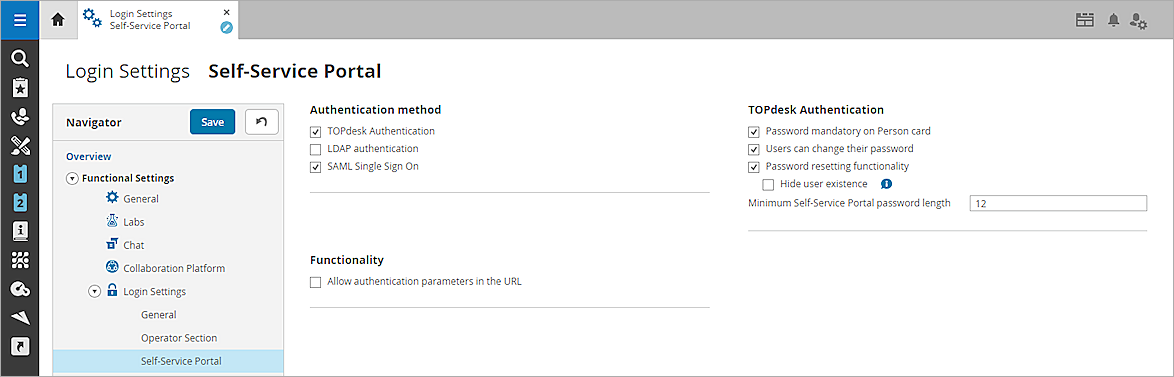
- Click Save.
Create a Person or Operator
Persons can log in to the Self-Service Portal, while operators can work in TOPdesk's Operator Section. For public SSO you should create a person to be a user. For secure SSO, you need to create an operator as a user. The email address of the person and operator matches the user's email address in AuthPoint. In this example, we create a person. For more information about how to create an operator, refer to the TOPdesk documentation.
- Log in to TOPdesk as an administrator.
- Click > New > Supporting Files > Person. To create an operator, you would select New > Supporting Files > Operator.

- In the Surname text box, type a surname.
- In the Email text box, type the email address of the user. This email address must exactly match the email address of the corresponding AuthPoint user account.
- From the Branch drop-down list, select a branch.
- In the Self-Service Portal section, next to Login name, click
 .
.
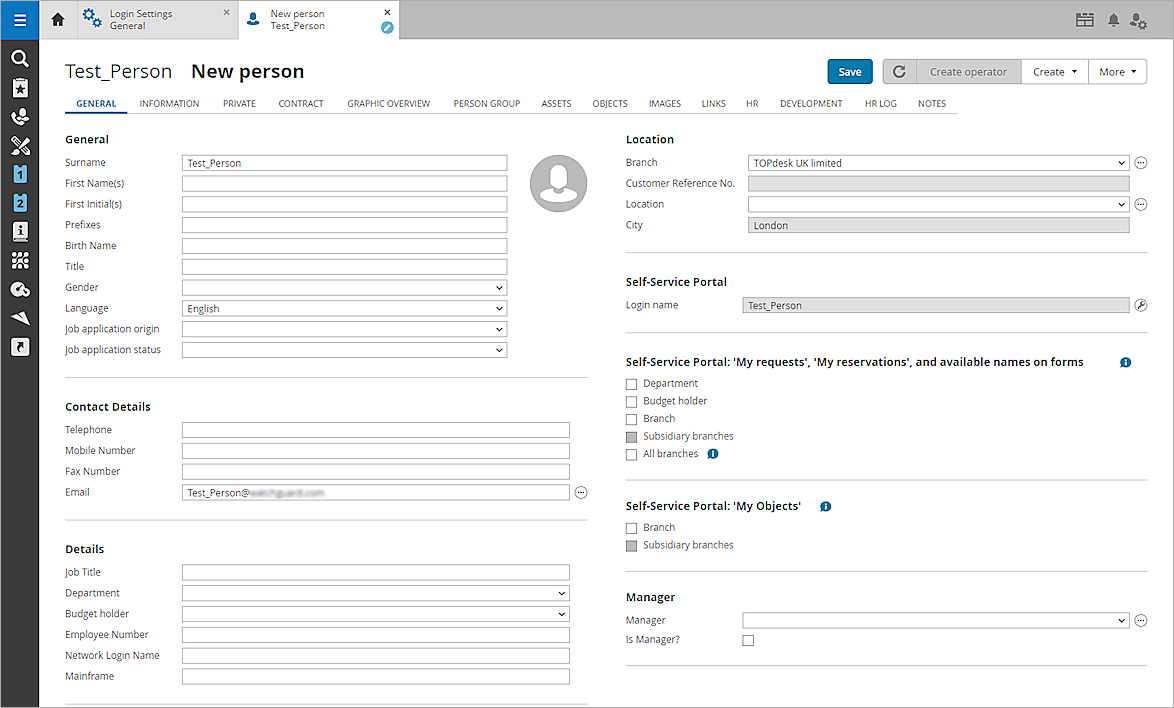
- In the Login data window, add the login credentials for this person.
- Click Save.
Configure AuthPoint
Before AuthPoint can receive authentication requests from TOPdesk, you must add a SAML resource in AuthPoint. You must also create a Zero Trust authentication policy for the TOPdesk resource to determine which users can authenticate and log in to TOPdesk and which authentication methods they can use (Push, QR code, and OTP).
Add a SAML Resource in AuthPoint
From the AuthPoint management UI:
- From the navigation menu, select Resources.
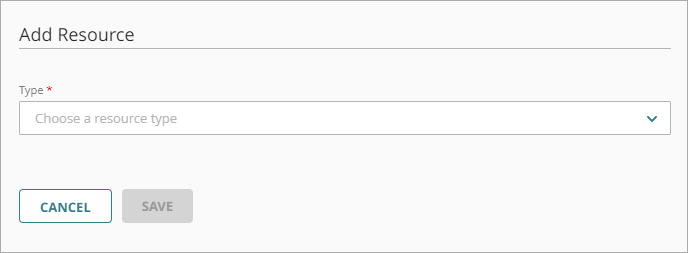
Click Add Resource.
The Add Resource page opens.
- From the Type drop-down list, select SAML.
Additional fields appear.
- On the SAML page, in the Name text box, type a name for this resource.
- From the Application Type (Integration Guide) drop-down list, select Others.
- Open the public metadata file that you downloaded from TOPdesk in Step 21 of the previous section and copy these values:
- entityID
- SingleLogout Location
- AssertionConsumerService Location
If you want to configure secure SSO, you also get these values from the secure metadata file.
- In the Service Provider Entity ID text box, paste the entityID value from the public or secure metadata file.
- In the Assertion Consumer Service text box, paste the AssertionConsumerService Location value from the public or secure metadata file.
- From the User ID sent on redirection to service provider drop-down list, select User Name.
- In the Logout URL text box, paste the SingleLogout Location value from the public or secure metadata file.
- From the Signature Method drop-down list, select SHA-256.
- From the AuthPoint Certificate drop-down list, select the AuthPoint certificate to associate with your resource. This must be the same certificate that you downloaded the metadata for in the previous section.
- Add a custom attribute for username.
- In the Custom Attributes section, click Add Attribute.
- In the Attribute Name text box, type username.
- From the Get Value From drop-down list, select User name.

Add a Group in AuthPoint
You must have at least one user group in AuthPoint to configure MFA. If you already have a group, you do not have to add another group.
To add a WatchGuard Cloud-hosted group to the WatchGuard Cloud Directory:
- Go to Configure > Directories and Domain Services.
- Click the WatchGuard Cloud Directory domain name. If you have not yet added the WatchGuard Cloud Directory, click Add Authentication Domain and select the WatchGuard Cloud Directory.
The New Group page appears.
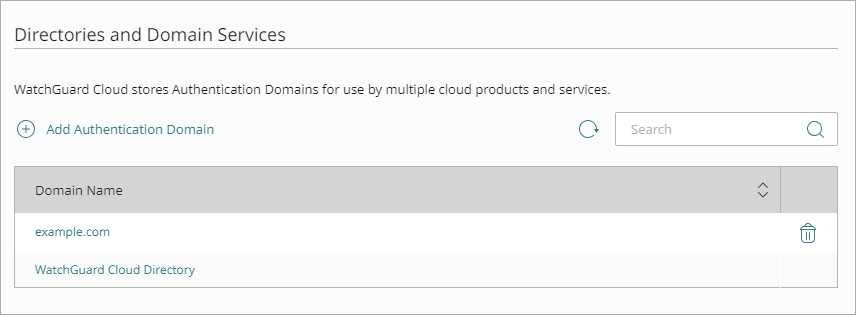
- In the Groups tab, click Add Group.
- In the Group Name text box, type a descriptive name for the group.
- (Optional) In the Description text box, type a description of the group.

- Click Save.
Your group is added to the WatchGuard Cloud Directory and to AuthPoint.
Add a Zero Trust Authentication Policy
Zero Trust policies specify which resources users can authenticate to and which authentication methods they can use (Push, QR code, and OTP).
You must have at least one Zero Trust authentication policy that includes the TOPdesk resource. If you already have Zero Trust authentication policies, you do not have to create a new authentication policy. You can add this resource to your existing authentication policies.
Users that do not have an authentication policy for a specific resource cannot authenticate to log in to that resource.
To configure a Zero Trust authentication policy:
- Go to Configure > Zero Trust. If you have a Service Provider account, you must select an account from Account Manager.
- Click Add Policy.
- Type a name for this policy.
- In the Target section, from the Content drop-down list, select which groups this policy applies to. You can make multiple selections to add multiple groups.
- In the Resources section, select the AuthPoint resources this policy applies to.
- In the Conditions section, select the conditions that apply to this policy. When you add a condition to an authentication policy, the policy applies only to user authentications that match the policy and the policy conditions. For example, if you add a Network Location to a policy, the policy only applies to user authentications that come from that Network Location. Users who only have a policy that includes a Network Location do not get access to the resource when they authenticate outside of that Network Location (because they do not have a policy that applies, not because authentication is denied). For more information, go to About Zero Trust Conditions.
- (Optional) To create a new condition, click Add New Condition. After you create a new condition, you must still add the condition to the policy.
- From the Type drop-down list, select the type of condition to add to the policy.
- From the Name drop-down list, select which condition of the chosen type to add to the policy.
- To add more conditions, repeat Step 6.
If you add conditions to a policy, we recommend that you create a second policy for the same groups and resources without the conditions. Assign a higher priority to the policy with the policy objects. For more information about priority, go to About Zero Trust Policy Precedence.
- In the Action section, select an option to specify whether to allow or deny authentications for the resources in this policy. In our example, we want to allow authentications.
- Allow — Allow user groups in this policy access to the resources associated with this policy.
- Deny — Deny authentications when users in the groups associated with this policy try to authenticate to the resources associated with this policy.
- If you allow access with this policy, select the check box for each authentication option users can select when they authenticate to resources in this policy with MFA.
For SAML resources, if you select more than one authentication option, users must select one of the available options when they authenticate. For example, if you select OTP and Push, users can choose to type their OTP or approve a push to authenticate. You cannot require that they do both.
- Click Save.
Your policy is created and added to the end of the policy list. - Review the order of your policies and adjust as necessary. For more information about priority, go to About Zero Trust Policy Precedence.
Add Users to AuthPoint
Before you assign users to a group, you must add the users to AuthPoint. There are two ways to add AuthPoint user accounts:
- Sync users from an external user database
- Add WatchGuard Cloud-hosted AuthPoint users
Each user must be a member of a group. You must add at least one group before you can add users to AuthPoint.

To import users from Active Directory, Microsoft Entra ID, or an LDAP database, you must add an external identity in the AuthPoint management UI. External identities connect to user databases to get user account information and validate passwords.
- To sync users from Active Directory or an LDAP database, you must add an LDAP external identity
- To sync users from Microsoft Entra ID, you must add a Microsoft Entra ID external identity
When you sync users from an external user database, you can sync any number of users and they are all added to AuthPoint at one time. Users synced from an external user database use the password defined for their user account as their AuthPoint password.
To learn how to sync users, go to Sync Users from Active Directory or LDAP and Sync Users from Azure Active Directory.
You create WatchGuard Cloud-hosted users and groups from the WatchGuard Cloud Directory in WatchGuard Cloud. Directories and Domain Services is where you add shared authentication domains for WatchGuard Cloud devices and services, such as AuthPoint.
Users that you add to the WatchGuard Cloud Directory are automatically added to AuthPoint as well.
You add local AuthPoint users form Directories and Domain Services. You manage the users in AuthPoint on the Users page.
When you add WatchGuard Cloud-hosted AuthPoint users, you choose whether the user is an MFA user or a non-MFA user.
- MFA users are user accounts that will use AuthPoint multi-factor authentication to authenticate. This is not related to the AuthPoint Multi-Factor Authentication license type.
- Non-MFA users are users that will only ever authenticate with a password, such as a service account user. Non-MFA users do not consume an AuthPoint user license and cannot authenticate to resources that require MFA. They can only authenticate to protected resources if the non-MFA user account has a password only authentication policy for that resource.
After you add a user, you can edit the user account if you need to change their account type. When you change a user account from MFA to non-MFA, AuthPoint deletes the tokens and password vault (if applicable) that belong to the user. This action cannot be undone.
Unlike users synced from an external user database, WatchGuard Cloud-hosted AuthPoint users define and manage their own AuthPoint password. When you add a WatchGuard Cloud-hosted user account, the user receives an email that prompts them to set their password.
To learn how to add WatchGuard Cloud-hosted AuthPoint user accounts to the WatchGuard Cloud Directory, go to Add Local Users to an Authentication Domain.
Test the Integration
To test AuthPoint MFA with TOPdesk, you can authenticate with a mobile token on your mobile device. You can choose any method (Push, QR code, or OTP). In this example, we show the push authentication method (users receive a push notification in the mobile app that they must approve to authenticate).
TOPdesk supports public(Self-Service Portal) and secure(Operator's Section) SSO. In this example, we use public SSO. You can use secure SSO in the same way.
- In a web browser, go to the Self-Service Portal (ttps://<your subdomain>.topdesk.net/tas/public/login/saml).
- Select the display name you configured in TOPdesk. In our example, we select AuthPoint_Public.
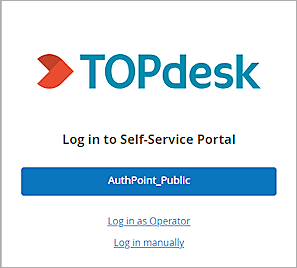
- Type your email address or AuthPoint user name. Click Next.
- If required, in the Password text box, type your password.
- For the authentication method, select Send Push.
- Approve the authentication request that is sent to your mobile device.
You are logged in to the TOPdesk Self-Service Portal.