Configure Dynamic DNS
Applies To: Locally-managed Fireboxes
Some of the features described in this version of Fireware Help are only available to participants in the WatchGuard Beta program. If a feature described in this topic is not available in your version of Fireware, it is a beta-only feature.
If you have an account with a dynamic DNS (DDNS) provider, you can enable dynamic DNS on an external interface to maintain the association between your domain name and the dynamic IP address assigned to your device.
The configuration options that appear depend on the provider that you select.

- Select Network > Dynamic DNS.
The Dynamic DNS client page appears. - Select a network interface and click Configure.
The Dynamic DNS configuration page appears.

- Select the Enable Dynamic DNS for interface check box.
- (Fireware v12.1.1 and higher) From the Provider drop-down list, select a dynamic DNS provider. In Fireware v2026.5 or higher, you can also select ipoe-static.ocn.ad.jp if your ISP requires this dynamic DNS update server. This option is commonly used with MAP-E connections. For more information about MAP-E, go to Configure MAP-E.
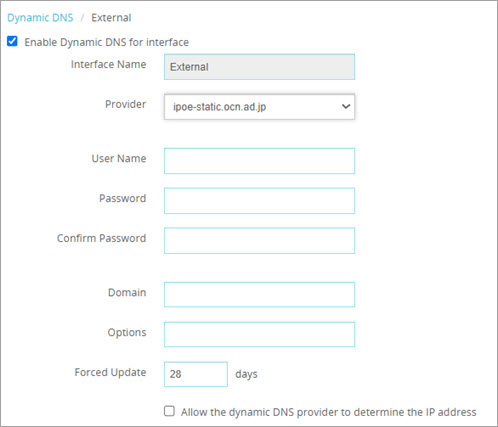
- Type the User Name you used to set up your dynamic DNS account. For ipoe-static.ocn.ad.jp, type the user name provided by your ISP.
- To specify the password, token, or key:
ipoe-static.ocn.ad.jp (Fireware v2026.5 or higher)
Type the password provided by your ISP.
Duckdns.org
Specify your duckdns.org account Token.

Cloudflare.com (Fireware v12.5.4 or higher)
In the Password text box, specify the Global API Key. This key appears in your cloudflare.com account at Overview > Get Your API Token.

All other providers
Type the Password you used to set up your dynamic DNS account.
- In the Domain text box, type the FQDN that you registered with your dynamic DNS provider. For ipoe-static.ocn.ad.jp, type the domain provided by your ISP.
- For dyn.com, no-ip.com, dynu.com, and duckdns.org, in the Options text box, type one or more of these options:
- mx=mailexchanger& — Specifies a Mail eXchanger (MX) for use with the hostname.
- backmx=YES|NO& — Requests that the MX in the previous parameter is set up as a backup MX (includes the host as an MX with a lower preference value).
- wildcard=ON|OFF|NOCHG& — Enables or disables wildcards for this host (specify ON to enable).
- offline=YES|NO — Sets the hostname to offline mode.
You can join one or more options with the ampersand character. For example:
&mx=backup.example.com&backmx=YES&wildcard=ON
For more information, see https://help.dyn.com/remote-access-api/perform-update or the documentation from your dynamic DNS service provider.
- In Policy Manager, select Network > Configuration.
- Select the WINS/DNS tab.
- Make sure you have defined at least one DNS server. If you have not, follow the procedure in Configure Network DNS and WINS Servers.
- Select the Dynamic DNS tab.

- Select the external interface for which you want to configure dynamic DNS and click Configure.
The Per Interface Dynamic DNS dialog box appears.
- To enable dynamic DNS, select the Enable Dynamic DNS check box.
- (Fireware v12.1.1 and higher) From the Provider drop-down list, select a dynamic DNS provider. In Fireware v2026.5 or higher, you can also select ipoe-static.ocn.ad.jp if your ISP requires this dynamic DNS update server. This option is commonly used with MAP-E connections. For more information about MAP-E, go to Configure MAP-E.
- Type the User Name you used to set up your dynamic DNS account. For ipoe-static.ocn.ad.jp, type the user name provided by your ISP.
- To specify the password, token, or key:
ipoe-static.ocn.ad.jp (Fireware v2026.5 or higher)
Type the password provided by your ISP.
Duckdns.org
Specify your duckdns.org account Token.

Cloudflare.com (Fireware v12.5.4 or higher)
In the Password text box, specify the Global API Key. This key appears in your cloudflare.com account at Overview > Get Your API Token.

All other providers
Type the Password you used to set up your dynamic DNS account.
- In the Domain text box, type the FQDN. For ipoe-static.ocn.ad.jp, type the domain provided by your ISP.
- For dyn.com, no-ip.com, dynu.com, and duckdns.org, in the Options text box, type one or more of these options:
- backmx=YES|NO& — Requests that the MX in the previous parameter is set up as a backup MX (includes the host as an MX with a lower preference value).
- wildcard=ON|OFF|NOCHG& — Enables or disables wildcards for this host (specify ON to enable).
- offline=YES|NO — Sets the hostname to offline mode.
You can join one or more options with the ampersand character. For example:
&mx=backup.example.com&backmx=YES&wildcard=ON
For more information, go to https://help.dyn.com/remote-access-api/perform-update or the documentation from your dynamic DNS service provider.
To configure dynamic DNS in WatchGuard Cloud, go to Configure Dynamic DNS.